
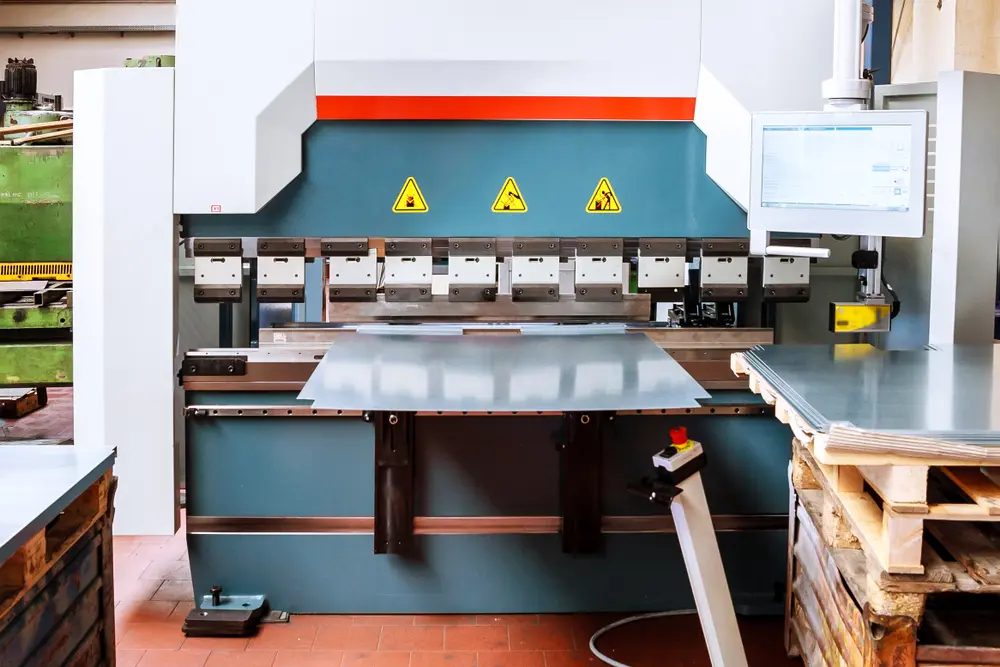
Sheet metal hemming is a simple but powerful process that improves both the function and appearance of fabricated parts. It involves folding the edge of a metal sheet back onto itself to create a reinforced, rounded, or flush edge. Hemming can eliminate sharp edges, strengthen the part, enhance its appearance, and help with proper alignment during assembly.
In this guide, we’ll explain what hemming in sheet metal is, the types of hem in sheet metal fabrication, how the process works, and why it matters in high-quality fabrication.
Key Takeaways
- Hemming folds the edge of sheet metal onto itself to create smooth, strong, and safe edges.
- Sheet metal hemming is commonly used for cosmetic, structural, or alignment purposes.
- Common types of hem in sheet metal include open, closed, teardrop, and rolled hems.
- Hemming is widely used in automotive, appliance, aerospace, and enclosure fabrication.
What Is Hemming in Sheet Metal?
Hemming is a metal forming technique where the edge of a sheet metal part is bent and folded back onto itself. Unlike a standard bend, which creates a simple angle, hemming involves creating a double-thickness edge with a much tighter radius. This results in a stronger, safer, and more refined edge that enhances both performance and appearance.
Hemming can be done manually or through automated processes. It’s used across a wide variety of applications—from household appliances to car doors—where edges need to be smooth, safe to touch, or prepared for welding or adhesive bonding. Hemming is also used to prevent edge deformation and increase rigidity in parts that undergo vibration or handling.
The process relies on accurate control of bend radius, material thickness, and forming method to avoid cracking or distortion. For thin, ductile metals, hemming is straightforward. For harder or thicker materials, careful design and precise tooling are essential.
Steps in the Hemming Process
While the specifics vary by process type and equipment, most hemming operations follow a structured workflow to ensure quality and repeatability. Here’s a typical breakdown:
- Material Selection: Choose a metal with good ductility. Aluminum and mild steel are common choices. Stainless steel can be hemmed, but it may require special preparation or slower forming speeds.
- Edge Preparation: Clean and deburr the edges of the sheet metal. Sharp burrs or notches can act as stress concentrators that lead to cracking during the hemming operation.
- Initial Bending (Pre-Hem): The edge of the part is bent to an intermediate angle—often 30° to 90°—in preparation for the final hem. This staged bending helps reduce cracking and provides better control over final hem geometry.
- Final Hem Forming: The edge is folded down to its final shape. This can be a closed, open, or rolled hem. Forming may be done in one step for thin materials or in two steps (pre-hem and flattening) for thicker parts.
- Finishing and Inspection: The hemmed edge is inspected for cracks, gaps, or inconsistent flattening. Some applications may require additional finishing, such as painting or powder coating after hemming.
Types of Hem in Sheet Metal
Sheet metal hems can be classified based on how the edge is folded and the resulting profile. Each hem type offers different strengths, space efficiency, and appearance.
Open Hem
An open hem is formed by bending the edge over with a consistent internal radius, leaving a small air gap inside. This hem type is not pressed flat and maintains a curved profile.
- Best for: Applications where rigidity is important but a flush edge is not necessary. Common in brackets, covers, or structural panels.
- Pros:
– Easier to form, especially in thicker materials.
– Adds strength to edges without compressing the material. - Cons:
– Slightly bulky profile.
– May allow moisture or contaminants into the fold.
Closed Hem
A closed hem folds the edge tightly against the base material, eliminating any internal gap. This creates a compact, smooth, and safe edge.
- Best for: Applications requiring space savings and clean aesthetics, such as appliance panels, car doors, or safety guards.
- Pros:
– Flush finish is safe for handling.
– Clean appearance suitable for exposed parts. - Cons:
– Difficult to form in thicker or harder materials.
– Higher risk of cracking without proper radius and tooling.
Teardrop Hem
A teardrop hem is a variation where the edge is rolled but not completely flattened. The resulting profile resembles a teardrop shape, combining elements of open and closed hems.
- Best for: Applications requiring both strength and flexibility, especially in decorative or stress-sensitive parts.
- Pros:
– Maintains material integrity under stress.
– Aesthetic shape ideal for visible components. - Cons:
– Requires more complex tooling.
– Not as compact as a closed hem.
Rolled Hem
A rolled hem is created using rollers or specialized dies that form a rounded, tubular edge. It’s often used in consumer products for safety and visual appeal.
- Best for: Furniture, consumer goods, signage, or panels with exposed edges.
- Pros:
– Consistent, smooth curve.
– Extremely safe and comfortable to touch. - Cons:
– Requires specialized forming equipment.
– Not suitable for all material types or tight spaces.
|
Hem Type |
Profile Description |
Best For |
Key Advantages |
Potential Drawbacks |
|---|---|---|---|---|
|
Open Hem |
Folded with a consistent internal radius; not flattened |
Structural parts, brackets, covers |
Easy to form; adds strength without compressing material |
Bulkier; may trap debris or moisture |
|
Closed Hem |
Fully flattened against the base material |
Automotive panels, appliances, tight assemblies |
Compact, clean finish; smooth and safe to handle |
Can crack in thick/hard metals; tighter tooling required |
|
Teardrop Hem |
Rolled into a looped shape without full compression |
Decorative parts, stress-sensitive applications |
Aesthetic, strong, reduced risk of cracking |
Complex tooling; not as space-efficient |
|
Rolled Hem |
Rounded edge formed with rotary or die tooling |
Furniture, signage, consumer products |
Consistent smooth edges; very safe and clean appearance |
Requires specialized equipment; may not fit tight spaces |
Technical Considerations in Hemming
To design and manufacture high-quality hemmed parts, engineers must consider several technical factors. These determine how well the hem will form, how it will function, and whether it can be produced efficiently.
Hem Length Guidelines
A good rule of thumb is to make the hem length between 4 and 6 times the material thickness. For example, with 0.030″ sheet metal, a hem length of at least 0.120″ ensures a durable fold. Shorter hems can be weak or prone to springback, while longer hems may wrinkle or require more forming force. Hem length also affects aesthetic uniformity and how easily the part can be handled or assembled.
Sheet Thickness
The thickness of the metal dramatically impacts formability. Thinner sheets are more flexible and easier to hem, but they can deform under pressure or lose flatness. Thicker materials resist deformation but are more prone to cracking and require wider bend radii. Designers must balance thickness, desired edge strength, and manufacturability when specifying hems.
Hemming Tools and Equipment
Different forming tools support different production needs:
- Press brakes with hemming dies are commonly used for prototyping or low-to-mid volume production.
- Rotary hemming machines are used for curved surfaces, especially in automotive panels.
- Robotic hemming systems are ideal for high-speed, high-precision environments.
Tool selection depends on factors like part geometry, run size, and material type.
Material Compatibility in Hemming
Hemming is only effective if the material can withstand the forming forces without cracking. Some materials are naturally better suited to hemming.
- Aluminum: Highly formable with minimal springback. Common in enclosures and aerospace panels.
- Cold-Rolled Steel: Offers a good balance of strength and ductility. Often used in structural and mechanical applications.
- Stainless Steel: Requires careful forming to avoid cracking, but provides excellent corrosion resistance.
- Copper / Brass: Very soft and formable; great for decorative trims or functional edges.
Avoid very hard, brittle, or pre-coated materials unless forming has been validated. Use simulation or trial runs when hemming less common alloys.
Industry Applications and Benefits
Hemming serves both functional and aesthetic roles, making it a versatile choice across industries. Its ability to provide smooth, reinforced edges gives it a key place in both mass production and precision fabrication.
- Automotive: Hems are used on doors, trunk lids, hoods, and interior panels. They enhance safety, rigidity, and edge alignment.
- Appliances: Panels on ovens, washers, and refrigerators use hemming for a sleek, safe edge finish.
- Aerospace: Lightweight aluminum panels are hemmed to reduce edge damage and improve aerodynamic smoothness.
- Electronics: Enclosures and rackmount equipment benefit from hemmed edges for better fit and finish.
Quality Assurance
Hemming must be held to precise standards to ensure consistent edge geometry and part performance. Quality control procedures ensure that parts function as intended and meet customer expectations.
- Visual Inspection: Look for cracks, surface marks, or deformed folds.
- Fixture Gauging: Use custom jigs to verify fold placement and hem width.
- Tactile Testing: Ensure edges are smooth and uniform to the touch.
Measurement and Tolerance Standards
- Typical tolerance for hem width is ±0.010–0.020 inches, depending on the forming process.
- Tools like calipers, micrometers, and laser scanners are used for validation.
- Any hem that interferes with mating parts, causes misalignment, or fails cosmetic inspection should be rejected or reworked.
Automation and Technological Advancements
Modern fabrication often relies on automation to meet speed, repeatability, and quality standards. Hemming is no exception.
Robotic Automation in Hemming
In high-volume production, especially in the automotive industry, robotic hemming systems have become standard. Roller hemming robots apply precise force across curved or complex surfaces, ensuring consistent edge geometry across thousands of parts.
These systems can operate 24/7, reduce operator fatigue, and produce hems that meet tight cosmetic and functional tolerances.
Industry 4.0 and Future-Ready Processes
Advanced hemming equipment can now integrate with smart manufacturing platforms. Features include:
- Real-time monitoring of forming force and machine condition.
- Data logging for process traceability and quality audits.
- Predictive maintenance to reduce downtime and tooling failures.
This shift makes hemming more scalable, efficient, and quality-assured than ever before.
Need Help With Custom Hemmed Parts?
At Precision Machine Fabrication, we know that even small details like edge treatment can make a big difference in part quality. Whether you need open hems on a production run of enclosures or closed hems on consumer panels, our team ensures precision with every fold.
We combine expert forming with thorough inspection processes to meet your design specs and timeline. Contact us today to learn how we can help with your next custom sheet metal project.
FAQs About Sheet Metal Hemming
What is hemming in sheet metal fabrication?Your Title Goes Here
Hemming folds the edge of a metal sheet back onto itself to create a smooth, strong edge.
What are the types of hem in sheet metal?
Common types include open hem, closed hem, teardrop hem, and rolled hem.
Is hemming possible on all metals?
Most ductile materials can be hemmed. Brittle or thick metals may crack without proper tools.
Can you hem with a press brake?
Yes, with the right dies and staging techniques, press brakes are commonly used for hemming.
Does hemming affect part dimensions?
Yes. Hemming adds material buildup at the edge and must be accounted for in part design.