
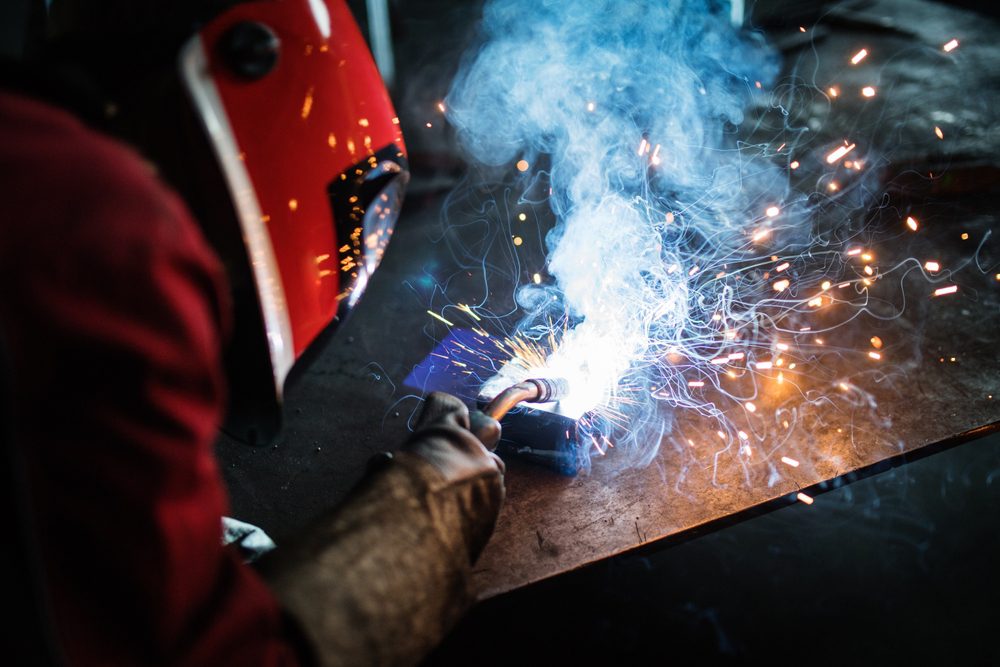
When selecting a welding method for your metal fabrication project, choosing between MIG and TIG welding is one of the most important decisions you’ll make. Each technique offers distinct benefits depending on the material type, joint complexity, finish requirements, and production volume.
At Precision Machine Fabrication (PMF), our skilled welders are experienced in both MIG and TIG welding, enabling us to tailor our approach to each project’s unique needs. In this guide, we’ll explore the differences between MIG and TIG welding, including how each process works, what applications they’re best suited for, and how to determine which method is right for your job.
Key Takeaways
- MIG welding is faster and easier to automate, making it well-suited for high-volume or structural fabrication.
- TIG welding provides greater precision and cleaner aesthetics, especially for thin or delicate materials.
- MIG is ideal for thicker metals and simpler welds, while TIG excels in intricate, visually exposed work.
- PMF utilizes both techniques, ensuring that every weld matches the material requirements and finish expectations of the project.
What Is MIG Welding?
MIG welding, or Metal Inert Gas welding, is a semi-automatic or automatic process that uses a consumable wire electrode fed continuously through a welding gun. The wire acts as both an electrode and filler material, melting into the joint as the arc heats the base metals. A shielding gas—typically a mix of argon and CO₂—is simultaneously dispensed to protect the weld pool from atmospheric contamination.
This process is known for its speed, consistency, and ease of use, making it popular in industries like automotive, construction, and general fabrication. Because of the continuous wire feed and relatively simple technique, MIG welding allows operators to make long, uniform welds quickly.
Key advantages of MIG welding:
- High deposition rates and fast welding speeds
- Easier to learn and operate, even for less experienced welders
- Compatible with thicker metals and longer welds
- Readily automatable for production and robotic welding applications
- Ideal for carbon steel, stainless steel, and aluminum with proper setup
What Is TIG Welding?
TIG welding, or Tungsten Inert Gas welding, is a manual process that uses a non-consumable tungsten electrode to create the arc. The welder typically feeds a separate filler rod into the molten weld pool while controlling the heat with a foot pedal or fingertip amperage control. A shielding gas—usually pure argon—protects the weld area from oxidation.
TIG welding offers unmatched control, allowing skilled welders to create extremely precise, clean welds. It is commonly used in industries that demand high-quality joints and aesthetic appearance, such as aerospace, medical device manufacturing, and precision sheet metal work.
Key advantages of TIG welding:
- Superior precision and control over heat input
- Clean, spatter-free welds that require little to no finishing
- Ideal for thin metals and sensitive alloys
- Excellent for welding stainless steel, aluminum, magnesium, and copper
- Allows for intricate welds on visually exposed surfaces
TIG welding does have a steeper learning curve and is significantly slower than MIG, but the tradeoff is premium weld quality—especially important for cosmetic or high-specification parts.
Comparing MIG vs TIG Welding
When deciding between MIG and TIG welding, it’s essential to evaluate multiple criteria—from material and thickness to visual finish and project timeline. Here’s how they compare:
Speed and Efficiency
When time is a critical factor, MIG tends to be the more efficient option. The continuous wire feed and relatively simple technique make it ideal for high-throughput environments like production lines and structural fabrication.
TIG, on the other hand, prioritizes precision over pace. Each weld demands greater control of heat and filler input, which naturally slows the process. It’s a better fit for detailed, low-volume work where quality matters more than speed.
Summary:
- MIG: Faster, higher productivity
- TIG: Slower, more deliberate for premium quality
Precision and Control
For applications where accuracy is non-negotiable, TIG offers a level of control that’s hard to beat. Skilled operators manage every variable—from amperage to filler feed—resulting in welds that are exceptionally clean and consistent.
While MIG delivers reliable performance, it doesn’t offer the same finesse. The process is better suited for straightforward joints where ultra-tight tolerances aren’t required.
Summary:
- TIG: Superior precision and finesse
- MIG: Efficient but less detailed
Appearance and Finish
Few welding methods can match the visual quality of a well-executed TIG weld. The resulting bead is smooth, consistent, and spatter-free—making it a top choice for visible or decorative joints that demand a polished look.
MIG tends to produce more spatter and may leave a rougher finish, especially on thicker materials. Post-weld grinding or cleanup is often necessary if aesthetics are a priority.
Summary:
- TIG: Cleaner, cosmetic welds
- MIG: Functional, may need finishing
Materials and Thickness
One of MIG’s strengths is its versatility with medium to thick materials. It performs well on a range of metals, including carbon steel, stainless steel, and aluminum—especially when production speed is a factor.
TIG is better suited for lighter-gauge metals and sensitive alloys. Its precise heat control helps avoid distortion or burn-through, making it ideal for thinner parts or specialty applications.
Summary:
- MIG: Best for thicker metals and structural applications
- TIG: Best for thin metals and specialty alloys
Ease of Use and Learning Curve
MIG is often considered more accessible for beginners. The process is relatively straightforward—once set up, operators can focus on steady hand movement without managing multiple inputs.
TIG, by contrast, requires a high level of coordination and experience. Controlling the arc, filler rod, and amperage simultaneously is challenging, but the payoff is exceptional weld quality when done correctly.
Summary:
- MIG: Easier to learn, more forgiving
- TIG: Requires greater skill and experience
Cost Considerations
In many cases, MIG is the more economical option—both in terms of time and material costs. Its speed and simplicity can significantly reduce labor hours, especially in repetitive or high-volume jobs.
TIG demands more time and a higher skill level, which often translates to increased labor costs. However, for low-volume, high-spec components, the investment in TIG can be well worth the superior results.
Summary:
- MIG: Lower cost per weld for production jobs
- TIG: Higher cost, but premium results
|
Category |
MIG Welding |
TIG Welding |
|
Speed |
Fast; high deposition rate |
Slow; more deliberate and controlled |
|
Precision |
Moderate precision; great for structural welds |
High precision; ideal for fine, detailed work |
|
Finish Quality |
More spatter; may require finishing |
Clean, smooth welds with little or no post-processing |
|
Ease of Use |
Easier to learn; beginner-friendly |
Complex; requires experience and coordination |
|
Material Compatibility |
Works well with steel, stainless steel, aluminum |
Excellent for thin metals, stainless, aluminum, magnesium |
|
Material Thickness |
Best for medium to thick materials |
Best for thin and delicate materials |
|
Automation |
Readily automated; compatible with robotics |
Mostly manual, limited automation |
|
Cost Efficiency |
Lower cost per weld for production jobs |
Higher labor costs; best for high-spec or small-batch jobs |
|
Common Applications |
Construction, automotive, general fabrication |
Aerospace, medical, architectural, food-grade work |
How PMF Delivers Precision Welding Solutions
At PMF, our team of AWS-certified welders brings decades of experience to every job. Whether your project demands the speed and efficiency of MIG welding or the finesse of TIG welding, we have the tools and expertise to get it done right.
Our facility is equipped with state-of-the-art welding equipment and rigorous quality control protocols to ensure every joint meets your specifications. We understand the nuances of both processes and guide our clients toward the most effective solution based on material, application, and performance requirements.
Whether you need durable structural welds or finely detailed cosmetic seams, PMF is ready to deliver precision and quality at scale. Contact us for more information today!
FAQs about MIG vs TIG Welding
Which welding method is stronger?
Both methods can create strong welds when applied correctly. The strength depends more on technique, joint design, and material prep than the process itself.
Can MIG and TIG welding be used on the same project?
Yes. Many complex assemblies use both MIG and TIG depending on the specific joint, material, and finish requirements.
Which welding method is better for aluminum?
TIG welding is preferred for aluminum due to its superior heat control and cleaner finish, especially for thin-gauge aluminum parts.
Why does PMF offer both MIG and TIG welding?
Offering both allows PMF to match the welding process to the project’s material, performance requirements, and aesthetic goals—ensuring optimal results every time.